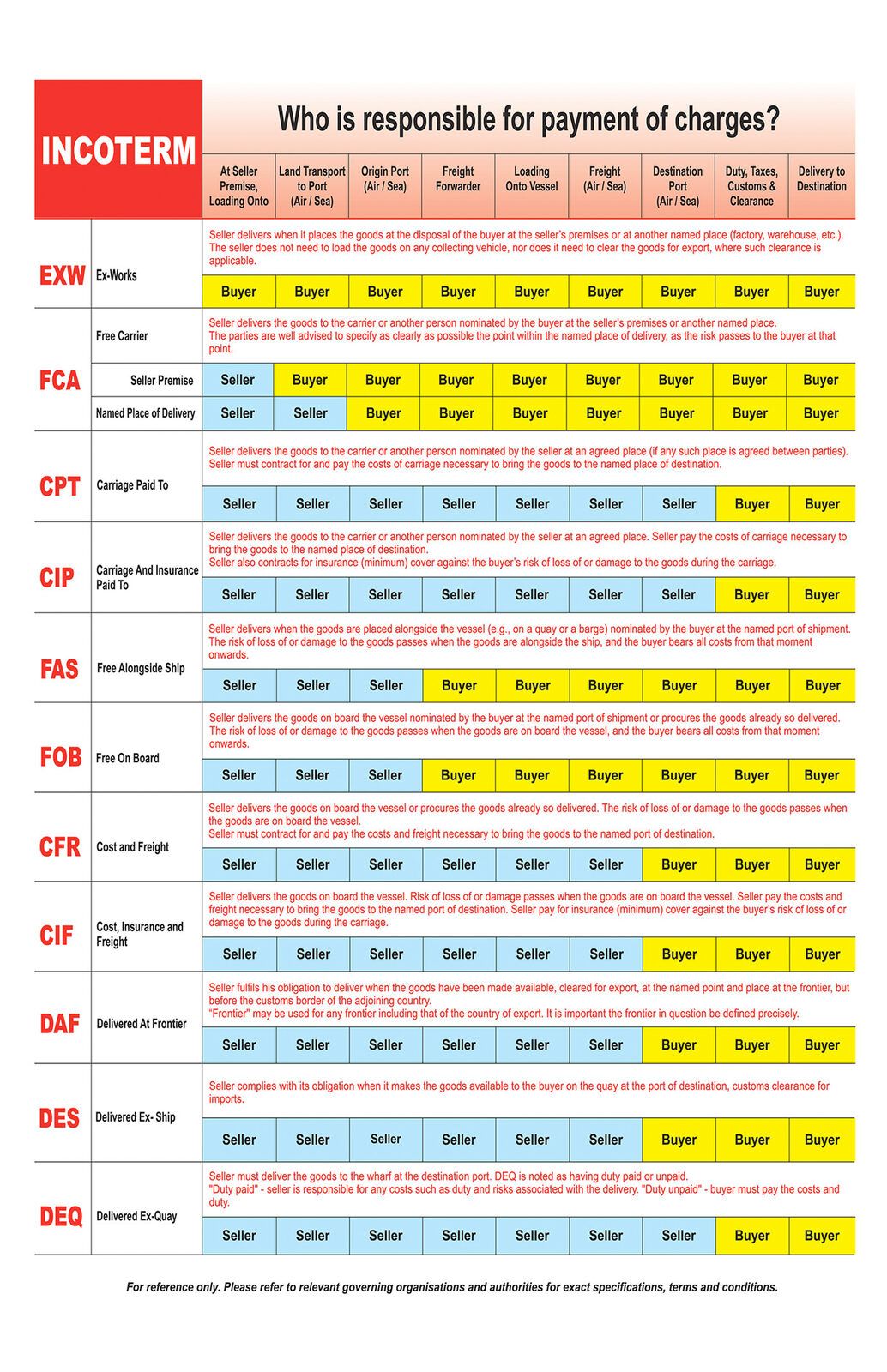
Incoterms define where the seller’s responsibility ends and the buyer’s begins. Picking the wrong one is one of the most common and most expensive mistakes in international trade. Use the matrix below as a quick guide, then confirm the exact term on your contract and commercial invoice.
A note on versions
The current rules published by the International Chamber of Commerce are Incoterms® 2020.
DAF, DES and DEQ were withdrawn in Incoterms 2010 and are shown separately below for reference only.
They still appear on older contracts. DAT was renamed DPU (Delivered at Place Unloaded) in 2020.
For reference only; please refer to the relevant governing organisations and authorities for exact specifications, terms and conditions.
Scroll the table sideways to see all stages. The Incoterm code stays in place.
Seller delivers when it places the goods at the disposal of the buyer at the seller’s premises or at another named place (factory, warehouse, etc.). The seller does not need to load the goods on any collecting vehicle, nor clear the goods for export where such clearance is applicable.
FCA
Free Carrier at seller premise
Seller delivers the goods to the carrier or another person nominated by the buyer at the seller’s premises. Parties are well advised to specify as clearly as possible the point within the named place of delivery, as risk passes to the buyer at that point.
FCA
Free Carrier at named place of delivery
As above, but delivery takes place at another named place rather than the seller’s premises; the seller therefore bears the land transport to that point.
Seller delivers the goods to the carrier or another person nominated by the seller at an agreed place. The seller must contract for and pay the costs of carriage necessary to bring the goods to the named place of destination.
CIP
Carriage and Insurance Paid To
As CPT, and in addition the seller contracts for insurance cover against the buyer’s risk of loss of or damage to the goods during carriage.
Seller delivers when the goods are placed alongside the vessel (e.g. on a quay or a barge) nominated by the buyer at the named port of shipment. Risk of loss or damage passes when the goods are alongside the ship, and the buyer bears all costs from that moment onwards.
Seller delivers the goods on board the vessel nominated by the buyer at the named port of shipment, or procures the goods already so delivered. Risk passes when the goods are on board, and the buyer bears all costs from that moment onwards.
Seller delivers the goods on board the vessel or procures the goods already so delivered. Risk passes when the goods are on board. The seller must contract for and pay the costs and freight necessary to bring the goods to the named port of destination.
CIF
Cost, Insurance and Freight
As CFR, and in addition the seller pays for insurance (minimum cover) against the buyer’s risk of loss of or damage to the goods during carriage.
Seller delivers when the goods are placed at the disposal of the buyer on the arriving means of transport, ready for unloading at the named place of destination. Risk passes at that point. The seller completes export formalities and bears all carriage and terminal expenses to the agreed destination point; import customs clearance, duties and taxes, as well as unloading at final destination, are for the buyer.
Seller is responsible for delivering the goods to the named place in the buyer’s country and pays all costs of bringing the goods there, including import duties and taxes. The seller is not responsible for unloading. This term places the maximum obligation on the seller and the minimum on the buyer; no risk or responsibility transfers until delivery at the named place of destination.
These three were removed in Incoterms 2010. They are documented here because they still appear in older contracts and letters of credit. If you receive one of these, ask your counterparty to restate the contract using a current term.
DAF
Delivered At Frontier
Seller fulfils its obligation to deliver when the goods have been made available, cleared for export, at the named point and place at the frontier, but before the customs border of the adjoining country. “Frontier” may be any frontier including that of the country of export; it is important that the frontier in question be defined precisely.
Seller complies with its obligation when it makes the goods available to the buyer on board the ship at the port of destination, not cleared for import.
Seller must deliver the goods to the wharf at the destination port. DEQ is noted as having duty paid or unpaid: “duty paid” means the seller is responsible for costs such as duty and the risks associated with delivery; “duty unpaid” means the buyer must pay those costs and duty.